Hello everybody, it is Brad, welcome to our recipe site. Today, I’m gonna show you how to make a special dish, japanese milk bread. One of my favorites. For mine, I’m gonna make it a little bit unique. This will be really delicious.
Japanese Milk Bread is one of the most favored of recent trending meals on earth. It’s easy, it is quick, it tastes yummy. It is appreciated by millions daily. Japanese Milk Bread is something which I have loved my whole life. They are fine and they look fantastic.
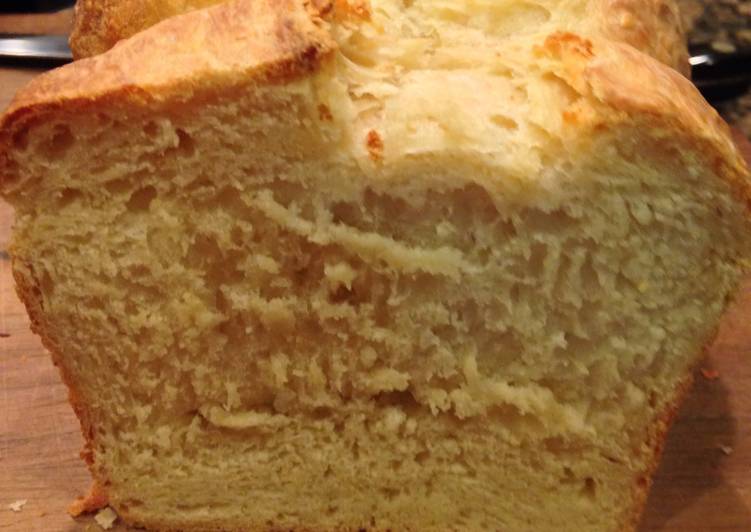
This Japanese milk bread is easier to cut through when it's at room temperature because of how soft it is. But you're more than welcome to tear right into it while still warm! 🙂. How to make the softest Hokkaido japanese milk bread without stand mixer or any machine with Tangzhong method (water roux). Japanese milk bread is probably the lightest, fluffiest, most tender bread you'll come across.
To begin with this recipe, we have to first prepare a few ingredients. You can have japanese milk bread using 13 ingredients and 7 steps. Here is how you can achieve that.
The ingredients needed to make Japanese Milk Bread:
- Make ready Starter
- Take 1/3 cup Bread Flour
- Make ready 1/2 cup Whole Milk
- Take 1/2 cup Water
- Prepare Dough
- Make ready 2 1/2 cup Bread Flour
- Make ready 1/4 cup Granulated Sugar
- Take 2 1/4 tsp Active Dry Yeast
- Make ready 1 tsp Sea Salt
- Prepare 1 Egg, lightly whisked at room temperatute
- Prepare 1/2 cup Whole Milk
- Take 1/4 cup Butter
- Take Heavy Cream for brushing
The flavor of a good loaf, the cracking sound of biting into a freshly baked baguette, and the texture of the soft crumb is. When panko, Japanese bread crumbs, first appeared here, American cooks leaped to embrace Surprisingly, milk bread with an incomparable crumb and buttery taste is a snap to make at home. I have tried different Japanese milk bread recipe. The interesting factor that attracted my attention was the hand-kneading pattern of this recipe.
Instructions to make Japanese Milk Bread:
- In a pot, mix all the Starter ingredients. Set to medium heat and stir often, until the starter has the consistency of mashed potatoes. Move it to a bowl, and cover with plastic wrap to cool to room temperature. This is the Starter.
- For the dough, whisk the bread flour, sugar, yeast, and salt. Next, add 1/2 cup of the cooled Starter mixture, as well as the egg and milk, and knead it.
- Add the butter to the dough and incorporate it fully, then knead until the dough is smooth and comes away from the edges of the bowl.
- Cover the bowl in plastic wrap and let the dough sit for an hour or until it doubles in volume.
- Grease a 9 x 4-inch pan with parchment paper. Transfer the dough to a floured counter, and divide the dough into four equal parts. Roll these into balls, working fast to prevent it from drying.
- Working with one ball of dough at a time, flatten the dough to an area of about 8 by 5 inches. Fold in about 1 inch from the sides, and then roll the dough into a log. Place the dough log seam-side down in the pan and repeat with the other dough balls. Cover the pan with plastic wrap and let it sit for 30-45 minutes.
- Lightly brush the top of the dough with heavy cream, and then bake in a 350°F (F) oven for 35-40 minutes or until the top of the bread is golden brown.
I have tried different Japanese milk bread recipe. The interesting factor that attracted my attention was the hand-kneading pattern of this recipe. Bread made with tangzhong is far and away superior to the pre-sliced, plastic-wrapped loaves that you'll find on grocery store shelves. Soft as clouds, white as snow, Japanese milk bread is the tender everyday loaf we want to bake right now. The precision required is an excellent excuse to buy a scale, but if you still want to measure out.
So that is going to wrap this up with this exceptional food japanese milk bread recipe. Thank you very much for reading. I am confident you will make this at home. There is gonna be more interesting food in home recipes coming up. Remember to bookmark this page on your browser, and share it to your family, colleague and friends. Thanks again for reading. Go on get cooking!