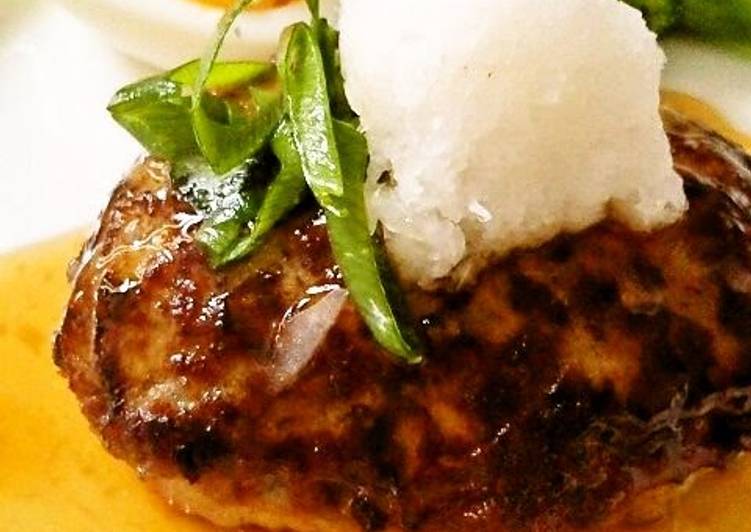
Hello everybody, it is Brad, welcome to our recipe page. Today, I’m gonna show you how to make a special dish, plump japanese-style hamburger steaks with grated daikon radish. One of my favorites food recipes. This time, I am going to make it a little bit tasty. This is gonna smell and look delicious.
Plump Japanese-style Hamburger Steaks with Grated Daikon Radish is one of the most popular of recent trending meals on earth. It is appreciated by millions daily. It’s simple, it’s fast, it tastes yummy. Plump Japanese-style Hamburger Steaks with Grated Daikon Radish is something which I have loved my entire life. They are nice and they look fantastic.
In a bowl, mix the ground meat, finely chopped onions, 〇 ingredients, and knead together. In a small saucepan, boil the ingredients for the sauce. One of my favorite ways to eat Hamburger Steak is with Daikon Oroshi (grated Daikon radish.) Daikon Oroshi is often used as a condiment and is especially great with rather oily food, such as Tempura and grilled mackerel fish. It has such a refreshing flavor and texture that compliments fatty meat or fish.
To get started with this recipe, we have to first prepare a few ingredients. You can have plump japanese-style hamburger steaks with grated daikon radish using 17 ingredients and 5 steps. Here is how you can achieve that.
The ingredients needed to make Plump Japanese-style Hamburger Steaks with Grated Daikon Radish:
- Get 400 grams Ground meat
- Make ready 1/2 Finely chopped onions (minced)
- Take 1 〇 Eggs
- Prepare 1 〇 Coarsely ground black pepper
- Take 1/2 tsp 〇 Salt
- Take 1/3 tsp 〇 Nutmeg
- Prepare 4 tbsp 〇 Panko
- Take 2 tbsp 〇 Milk
- Prepare For the sauce:
- Take 100 ml Water
- Make ready 50 ml Cooking sake
- Prepare 2 tbsp Soy sauce
- Get 1 tbsp Sugar
- Get 2 cm from a tube Grated ginger
- Make ready 1 Katakuriko slurry (1:2 start to water ratio)
- Prepare 1 Shiso leaves green onions
- Prepare 1 Grated daikon radish
It can be used as a condiment and often added to sauces. The meat patty is prepared until moist and flavorful, and garnished with daikon, shiso leaves and enjoyed with a ponzu based sauce. The distinct flavor of Hambāgu comes from the set of Asian seasoning used. hamburger steak is prepared with wine, Worcestershire sauce, soy sauce, and oyster sauce. In addition, chefs made Hambāgu with a mix of beef and pork or added with tofu and chicken meat.
Instructions to make Plump Japanese-style Hamburger Steaks with Grated Daikon Radish:
- In a bowl, mix the ground meat, finely chopped onions, 〇 ingredients, and knead together. Knead until completely incorporated.
- In a small saucepan, boil the ingredients for the sauce. Thicken with the water-dissolved katakuriko.
- Shape the meat mixture into 4 portions, and pat out the air pockets with the palm of your hands. Line on a heated pan with oil and cook over high heat to brown both sides.
- Reduce to low heat and cover with a lid to steam cook. Cook all the way through. Stick a toothpick through, and it's done if the juices run clear.
- Arrange on a plate, top with grated daikon radish, shiso leaves, and green onions and pour the sauce over.
The distinct flavor of Hambāgu comes from the set of Asian seasoning used. hamburger steak is prepared with wine, Worcestershire sauce, soy sauce, and oyster sauce. In addition, chefs made Hambāgu with a mix of beef and pork or added with tofu and chicken meat. Variations of Japanese Hamburger Steak The common theme for all these hamburger steaks is that they are made from a blend of minced beef and other ingredients. There are many variations of Hambāgu in Japan, like Wafu Hambāgu (soy sauce-based sauce with grated daikon), Teriyaki Hambāgu, Demi-glacé Hambāgu, and more. Daikon oroshi means grated daikon radish in Japanese.
So that’s going to wrap it up for this exceptional food plump japanese-style hamburger steaks with grated daikon radish recipe. Thank you very much for reading. I am sure that you will make this at home. There’s gonna be interesting food at home recipes coming up. Don’t forget to bookmark this page in your browser, and share it to your family, colleague and friends. Thanks again for reading. Go on get cooking!